
Madison Parish Criminal Court Cases
The Sixth Judicial District Court is the main trial court for Madison Parish criminal cases. It serves Madison, East Carroll, and Tensas parishes, and has original authority over criminal matters that state law does not assign only to another court. Its two divisions hear felony prosecutions and other state-law cases filed in Madison Parish. The Madison Parish Clerk of Court keeps the pleadings, minute entries, orders, judgments, and other official case material. A municipal or justice court may keep a lower-level citation, ordinance case, or bench warrant within its own authority, so not every local matter will appear in the district court file.
The Louisiana Supreme Court provides statewide judicial resources, though those resources do not replace the Madison Parish trial record.
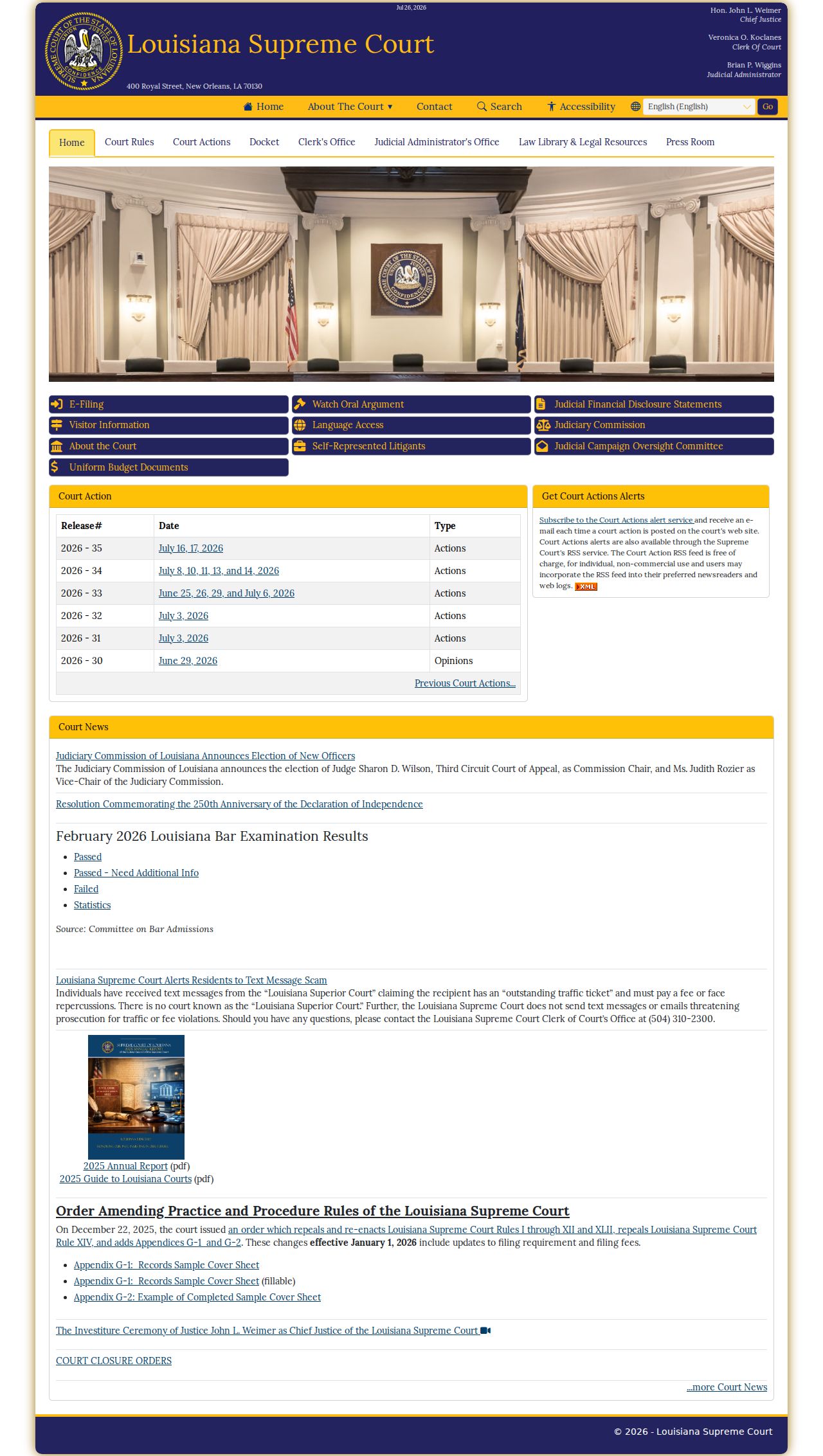
The court hierarchy helps identify where an appeal or statewide rule belongs, while the Madison Parish Clerk remains the source for the district case file.
Inside Madison Parish Sixth JDC
A Madison Parish docket may identify Division A or Division B. The division points to the assigned judge and courtroom track; it does not create a second version of the same prosecution. The docket header should also show the case number, filing date, caption, case type, and current status. The charging document may be a bill of information or indictment. Each count should identify the alleged offense and governing statute. A filing remains an allegation until the court enters a plea, verdict, dismissal, or other outcome.
Keep the court file separate from the jail record. The sheriff acts as parish jailer and keeps booking information, but a booked charge may change after prosecutor review. The clerk's file shows what was formally filed and what the judge did. Readers tracing the event from custody onward can compare the court result with the separate Madison Parish arrest lookup process.
That three-parish district structure can also cause confusion. A judge or program may serve the whole Sixth JDC, yet the file for a Madison Parish prosecution still belongs with the Madison Parish Clerk. Confirm the parish named in the caption before ordering. When two defendants or related events produce separate files, ask whether the docket lists a companion case rather than assuming one file contains every charge.
Searching Madison Parish Case Records
No verified free Madison Parish case-search portal was found. Start with the Clerk at the courthouse, by telephone, or through a focused written request. Ask whether Madison Parish currently participates in LCRAA or Clerk Connect, and confirm remote coverage and any charge before relying on it. A name plus a narrow year range may work, but a case number is the strongest key. Use this five-step path:
- Identify whether the matter belongs to Sixth JDC, a municipal or justice court, or federal court.
- Give the clerk the defendant's full docketed name and case number, if known.
- Add the filing or arrest year, offense, and court division to separate close matches.
- Ask for the docket, minutes, charging paper, count-level disposition, and judgment or sentence needed.
- Request a certified copy when the record will support a correction, expungement filing, or other formal process.
Because there is no confirmed public form, these are clerk request inputs, not invented portal controls.
| Field Label | Type | Required | Notes |
|---|---|---|---|
| Defendant full name | Text | Yes without case number | Include middle name or former spelling. |
| Case number | Text | Preferred | Ask for the exact Sixth JDC format. |
| Filing or arrest year | Number/range | No | Narrows common names and archives. |
| Date of birth | Date | No | Give only if the clerk accepts it; do not republish it. |
| Charge or division | Text/choice | No | Use the offense and Division A or B when known. |
Older Madison Parish Case Files
A missing remote result does not prove that no Madison Parish criminal case exists. Older material may require an archive search, microfilm review, or retrieval of a paper file. Give the clerk a narrow filing range and all known name variants. Ask whether staff search, retrieval, copying, or certification charges apply before ordering. The official sources did not publish Madison Parish criminal-counter hours or a criminal-copy fee schedule, so neither should be assumed.
If the district clerk cannot locate the matter, confirm whether a municipal or justice court was the issuing court. A low-level citation or local bench warrant can remain outside Sixth JDC. For a district case, ask whether a companion case, appeal number, or prior case is cross-referenced. These clues can reveal why the expected record sits under another number.
The Louisiana court interpreter program explains the statewide framework for language access in court proceedings.
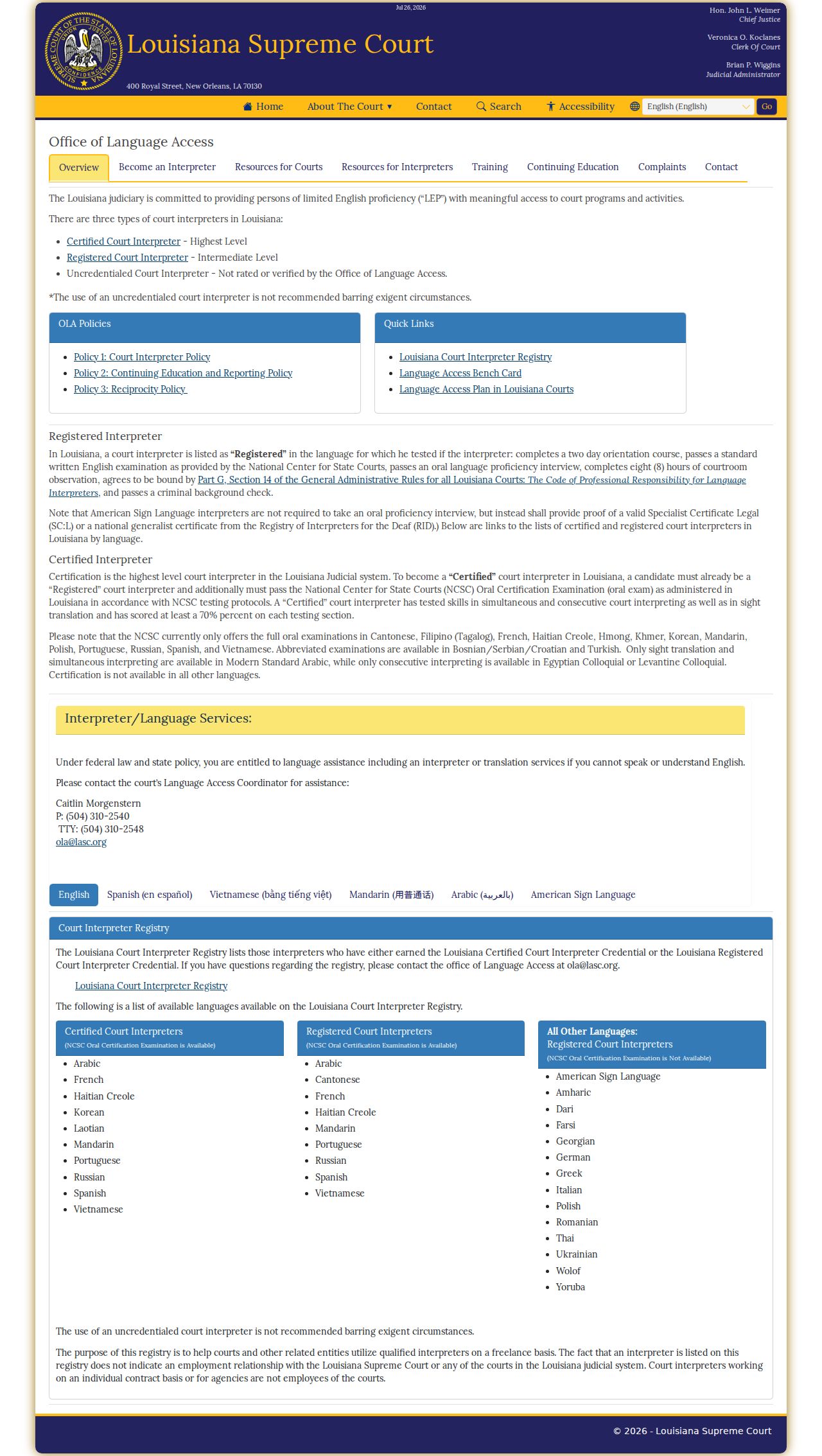
Interpreter access concerns the proceeding itself; the clerk can explain what public minute entry or order documents that event in a Madison Parish file.
Inside a Madison Parish Case File
The Madison Parish criminal case file joins the charge, court events, and final outcome. A docket is the running index of those events, while minutes record what occurred in court. The judgment and sentence give the strongest account of the result. Ask for the exact document rather than a broad file when one fact is needed.
| Case Number & Court | Identifies Sixth JDC, the filing, division or judge, case type, and status. |
|---|---|
| Charging Document | Lists the filed counts, alleged offenses, statutes, and offense dates. |
| Docket Entries | Indexes filings, motions, continuances, pleas, trial events, warrants, and orders. |
| Hearing Dates | Shows arraignment, motion, trial, sentencing, and revocation settings when entered. |
| Disposition & Judgment | States the outcome for each count, including dismissal, amendment, plea, or verdict. |
| Sentence & Conditions | Records custody, probation, credit for time, fines, costs, or restitution when public. |
A rap sheet and one Madison Parish case file answer different questions. LACCH can connect Louisiana arrest and disposition cycles by fingerprint. The court file adds motions, counsel, hearing detail, evidence rulings, and the judge's orders, but it cannot reveal unrelated cases elsewhere in the state.
Reading Madison Parish Case Outcomes
Do not stop at a status marked “disposed.” That word says the case reached an endpoint, not how each count ended. One count may be dismissed while another is amended or resolved by plea. Read the disposition line for every count, then compare it with the signed judgment and sentence. A dismissal also does not erase the sheriff's booking record. If a state repository entry lacks the result, a certified Madison Parish disposition can support a correction request.
Warrant entries need the same care. A docket may show that a capias, which is a court order to take a person into custody, was issued after a missed appearance. A later entry may recall or satisfy it. Obtain current confirmation from the issuing court before treating an older docket line as active. Presentence reports, juvenile material, sealed filings, protected victim data, and some evidence may not be available in the public file.
How a Criminal Case Moves
After an arrest or investigation, the district attorney decides whether and how to file charges in Madison Parish. Arraignment records the defendant's response to those charges. Motions, hearings, and continuances then shape the pretrial record. The matter may end through dismissal, a plea, or a trial and verdict. If there is a conviction, the court enters judgment and sentence. No fixed local timetable was published, so a docket's dated entries are the best way to follow one Madison Parish case.
Case flow: Charges Filed › Arraignment › Pretrial › Plea or Trial › Disposition › Sentencing
Madison Parish and Federal Cases
Federal prosecutions arising from Madison Parish belong to the Western District of Louisiana, not Sixth JDC. PACER is the official federal court-record service. It requires registration and applies its current fee schedule, with the exemptions and quarterly waiver rules stated by the federal judiciary.
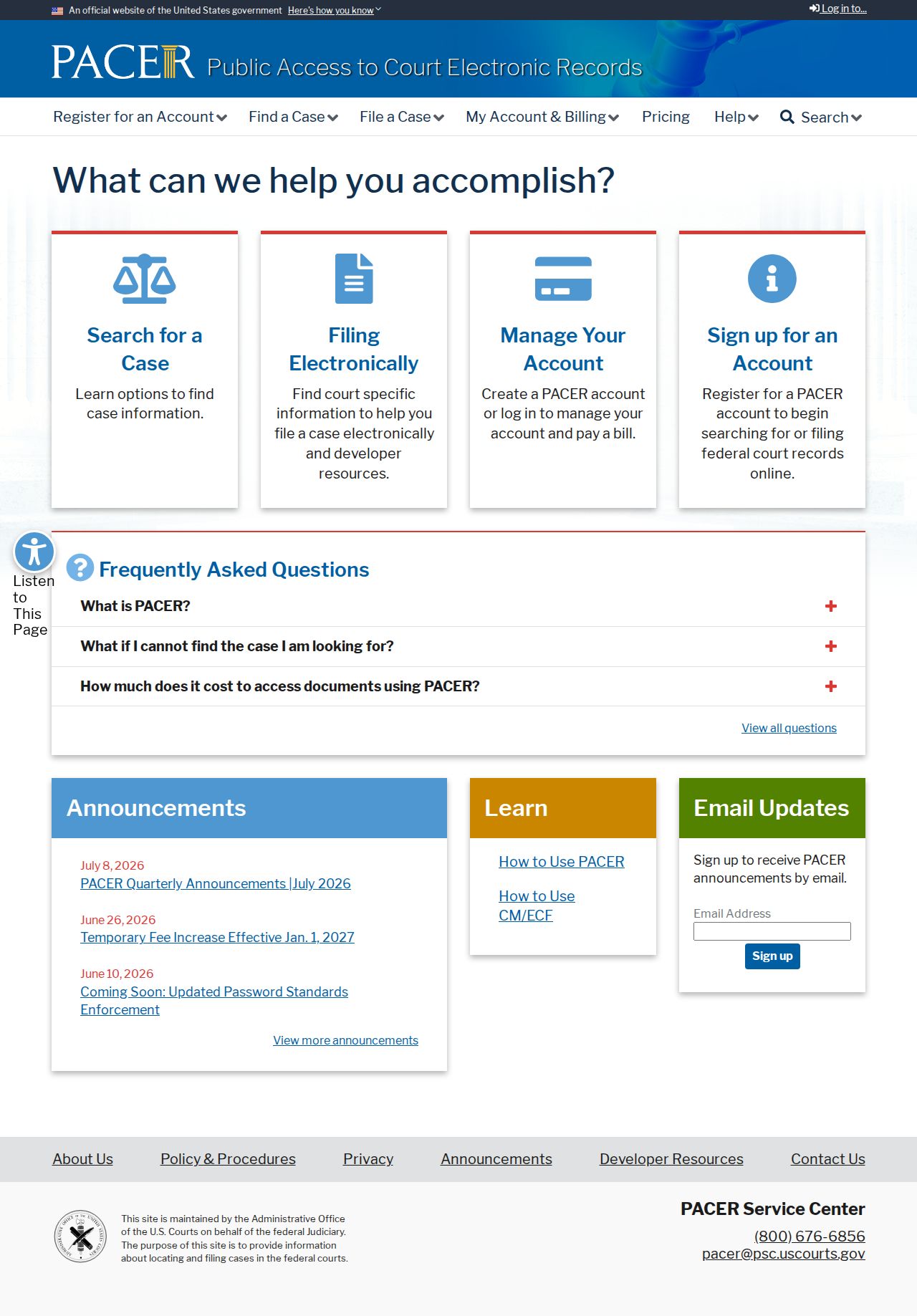
PACER searches by party name or federal case number and provides the docket entries and available documents for that separate court system.
The Western District of Louisiana identifies the federal court serving Madison Parish.
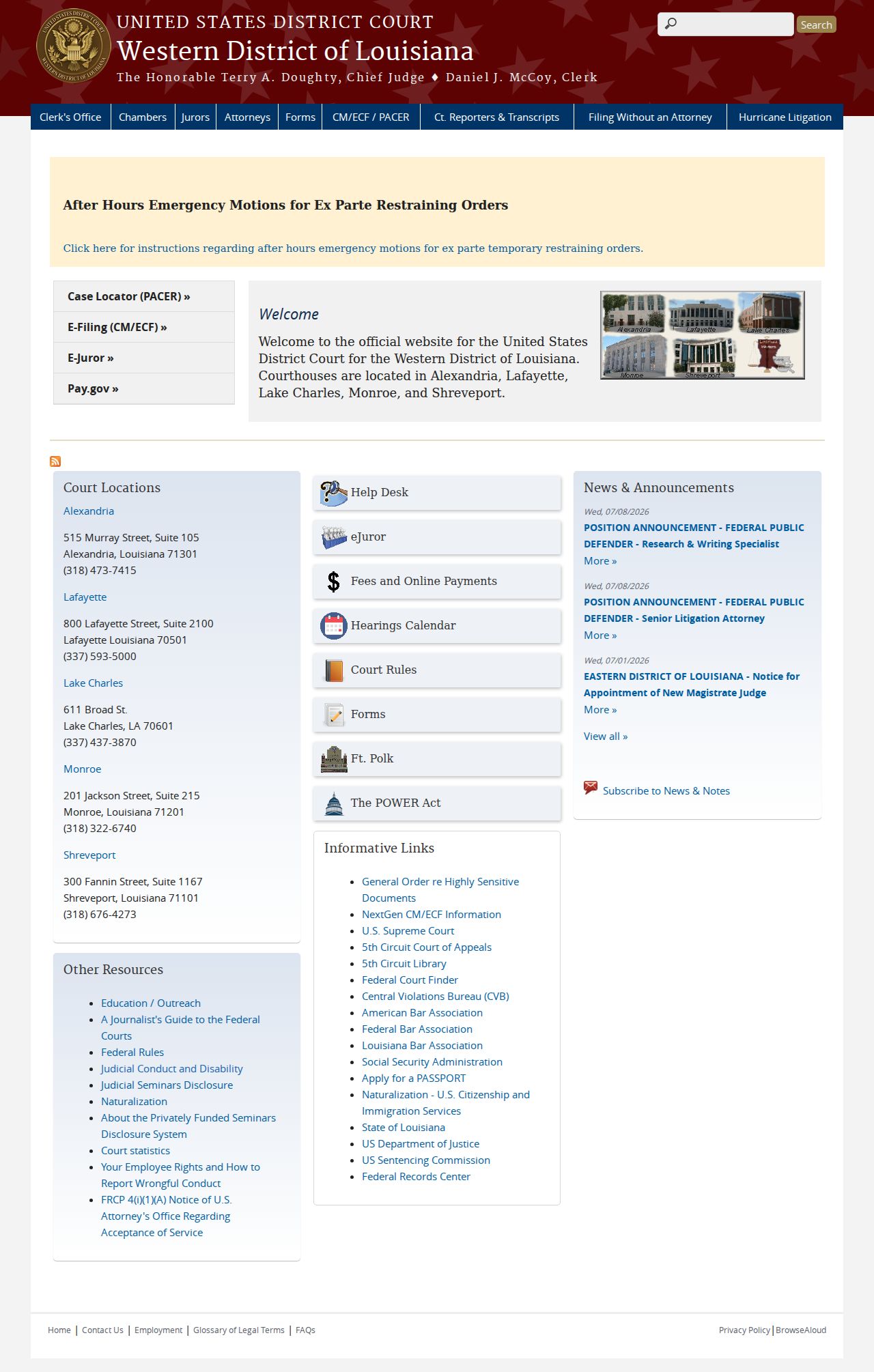
A federal docket may show the office or division, judge, charges, counsel, event dates, judgment, and appeal references. Sealed documents and protected identifiers remain unavailable.
Case Record Access & Restrictions
Louisiana R.S. 44:1 broadly defines public records and identifies the custodian concept used in public business.
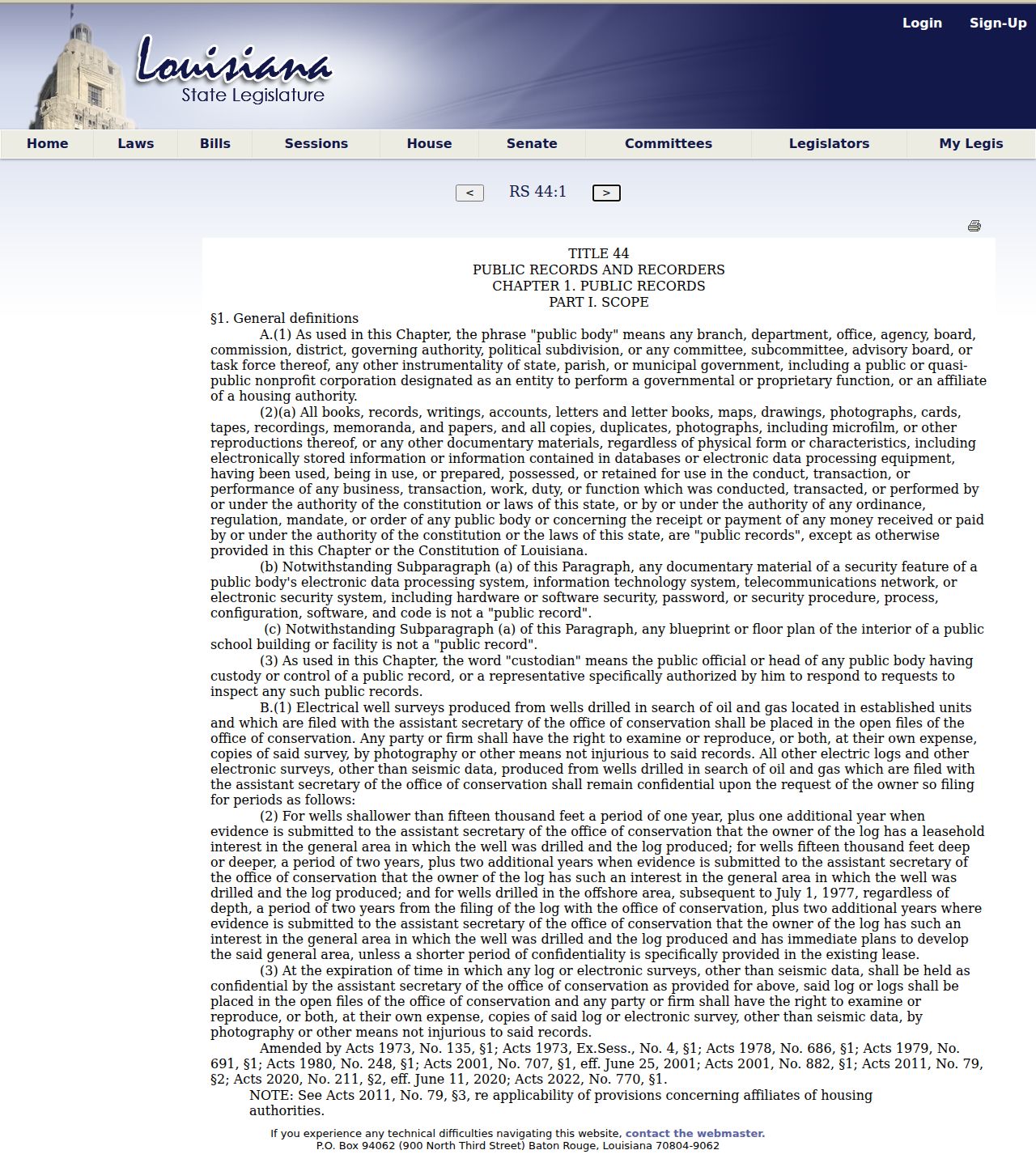
That broad definition supports a focused request, but court rules, sealing orders, and specific confidentiality laws still govern what the clerk may release.
The Legislature also names the governing chapter the Louisiana Public Records Law.
Juvenile records, sealed or expunged material, protected victim details, medical information, and personal identifiers may be withheld or redacted. Louisiana's closed criminal-history rules also mean public access to a court file is not public access to a complete state rap sheet.
Requesting Madison Parish Certified Records
Address the request to the office that controls the record. Ask the Madison Parish Clerk for the docket, charging instrument, minutes, disposition, judgment, sentence, or certified copy. Ask the sheriff for booking and jail records. If the clerk has no record, ask which court or agency may hold it. A written denial should state its legal basis, and R.S. 44:35 supplies remedies under public-record law.
State the case number, docketed name, approximate year, and precise document sought. Request an electronic copy or inspection if either will meet the need, and ask for a cost estimate. For a correction or expungement filing, obtain the count-level disposition and certification rather than relying on a screen print. The broader Madison Parish criminal history chain may also require the booking agency's record and the subject's own fingerprint-based Right to Review.
A narrow request is easier to route and review. “The disposition and sentence in case number X” identifies a court record, while “everything about this person” may reach records held by several offices. Keep the clerk's response with the case number and certification page. If an entry appears wrong or incomplete, point to the exact docket date or count and provide the certified order that supports the correction.